
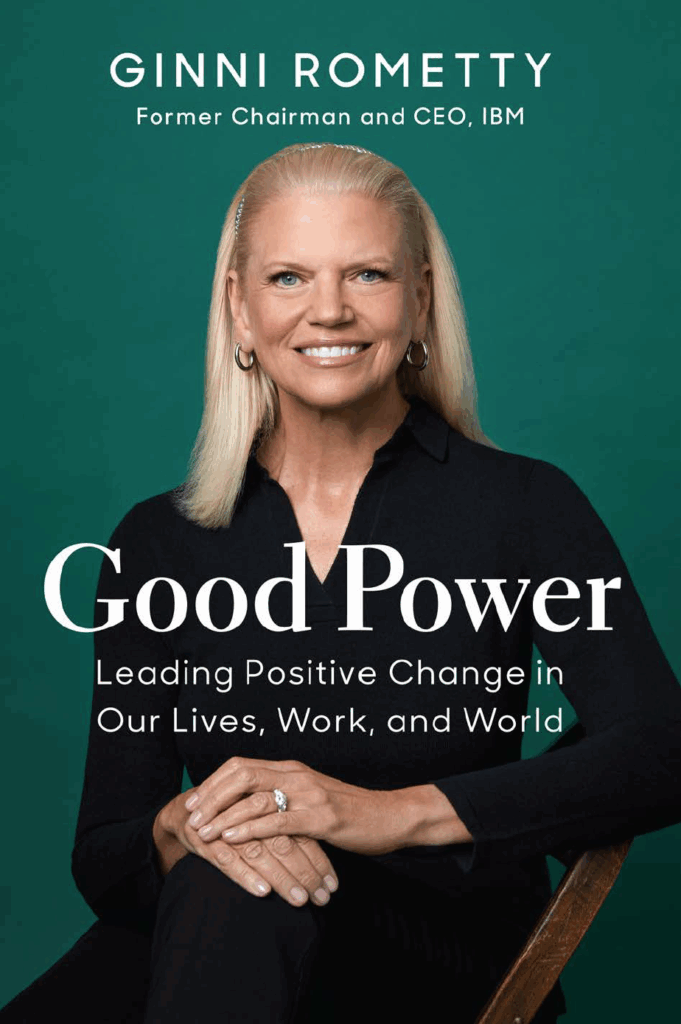
Author: Ginni Rometty
Good Power recounts how Ginni Rometty began her career as an entry-level systems engineer at IBM and rose to become its first female CEO. Through stories from her childhood and career, Rometty explores how service-oriented leadership—what she calls “good power”—can drive inclusive transformation in business and society.
Rometty wrote this memoir after retiring as IBM’s CEO in 2020. The story spans her life from childhood through her career at IBM, tracing her journey through Detroit and New York starting in the 1970s—a period marked by rapid technological and social change.
At sixteen, Ginni Rometty’s life changed when she overheard her father say to her mother, “For all I care, you can go work on the street.” He left soon after, plunging her mother and siblings into financial crisis. But her mother enrolled in community college and took night jobs, proving that dignity and progress could be reclaimed through courage. That moment—watching her mother rise from heartbreak to strength—became Ginni’s first exposure to what she would later call “good power.”
Rometty earned a scholarship to Northwestern, studying computer science while working multiple jobs and living on a tight budget. After graduating, she joined IBM in 1981. In the male-dominated tech world, she stood out—not just as a woman, but as someone with relentless curiosity. Her early mentor told her bluntly: “If you want to move up… consider how senior executives look.”
She didn’t back down. She worked harder and gained real knowledge instead of relying on appearances.
Throughout her career, she refused to rely solely on authority. Instead, she emphasized “building belief”—motivating others not by force, but by clarity and shared purpose. When IBM acquired PwC’s consulting arm, it was Rometty who led the integration, managing skepticism from both cultures. She brought PwC’s partners to her home, listened to their fears, and made them feel seen: “I believed in the merger so much that I was staking my own career on it.”
Rometty later became IBM’s CEO in 2012, leading it through one of its most turbulent reinventions. She introduced “SkillsFirst” hiring, advocating for candidates based on ability, not just degrees. She took on systemic problems, including tech ethics, and pushed IBM to ask: “Who are we, and who do we want to be?”
She ends with this truth: “Good power is not about commanding from above. It’s about lifting others from where they are.”
Rometty wrote this memoir to redefine how power can be used—not to control, but to serve and uplift. Her goal is to show that leadership rooted in respect, inclusion, and results is not only possible but also transformative. The key lesson she offers is this: power can be good when it is used to unite, to bridge differences, and to create tangible progress for the many, not the few. Whether in a boardroom or a family home, we all have the ability to choose “good power” and lead positive change from wherever we stand.